Together for participatory water science!
What is the Québec Water Collective?
The Québec Water Collective is bringing together non-profit organizations, community groups, schools, universities, research groups, scientists, government entities, businesses, communities, Indigenous and non-indigenous, who carry out participatory water science initiatives in Québec.
Through the activities of the Québec Water Collective (in-person and online meetings, training, networking activities, etc.), members will collaborate on various issues to advance participatory water science in Québec.
Mandated by the Collective‘s strategic committee, G3E develops this new network and coordinates its activities. The strategic committee supports G3E in major decisions related to the development and maintenance of the Collective.
The Québec Water Collective emerged from the Participatory Water Science Forum in November 2022. During this event, around sixty participants from various backgrounds gathered. Together, they defined a vision of what participatory science should be in Québec. After discussing the strengths, weaknesses and challenges of participatory science, these two days of discussions and exchanges concluded with the development of an action plan which will be implemented in the coming years.
For all the details and documents from the Participatory Water Science Forum, click here.
The Collective’s mission is to mobilize the knowledge of participatory water science stakeholders in Québec and encourage their commitment, in an innovative and inclusive way, by offering members of the Collective opportunities to network, learn and work together.
For more details on the values, objectives, and action plan of the Collective, please see this presentation document.
The Collective’s vision is a participatory science network for water health, recognized for the sustainable commitment of communities, the diversity of actors as well as for scientific and traditional knowledge sharing.
Inclusive vision
Every member follow the same direction toward a common goal.
Engagement
All the players in citizen water science in Quebec are sustainably committed to keeping water healthy.
Durability
Through funding and resources development strategies, working towards the long-term continuity of the Collective and its actions.
Data credibility
Getting the practice of citizen science recognized, as well as the acceptance of the data gathered by its participants.
Knowledge sharing
Set up solutions for data inventory, knowledge sharing, and considering citizen science in political and public decision-making related to water conservation.
For more details on the values, objectives, and action plan of the Collective, please see this presentation document.
The organizational and functional structure of the Collective is made up of a strategic committee, a scientific committee, members, and the coordination team.
- The strategic committee ensures smooth operations and guides strategic decisions.
- The scientific committee mainly acts as an expert panel on the scientific credibility of the participatory approach to water health.
- The Water Education and Eco-Monitoring Group (G3E) handles the overall coordination of the Collective.
- Members help advance citizen science in water in Quebec by getting involved in developing activities that meet their needs.
These different structures are supported by:
- Practice committees that make it easier to share experiences and know-how among members.
- Working groups that help carry out a project or specific action contributing to the Collective’s strategic vision.
What is participatory science?
The term “participatory science” can be used in several formulations: citizen science, community science, collaborative science, community-based water monitoring, active observation, environmental monitoring by citizens, etc.
Within the Québec Water Collective, participatory science brings together all initiatives and actions involving non-scientists in the various stages of data collection projects in science (e.g.: definition of issues, sampling, monitoring, etc.).
Québec Water Collective initiatives
Map listing participatory water science initiatives in Québec
To paint a portrait of participatory water science in Québec and to highlight its stakeholders, the Québec Water Collective wishes to bring together all the participatory water science initiatives carried out in the province on an interactive map. When online, this map will make your initiative known to the public and promote your group’s contribution to participatory water science in Québec!
Leading an initiative? Make it shine starting today!
G3E is already collecting the information which will be added to it via an online form. The information requested is related to the initiatives (group or organization, contact details, target audience, geographic scope, etc.). This is a directory and not a database. Data collected through your initiatives is not requested in the form and will therefore not be published on the map.
Add your initiative here! (This form is currently offered in French. An English version may be available in the future)
Interactive map of water citizen science
Become a member of the Québec Water Collective
It is now possible to become a member of the Québec Water Collective!
You can already consult the membership criteria and prices, as well as the member benefits.
The members of the Québec Water Collective undertake to participate in the Collective‘s efforts to promote participatory water science in Québec and contribute to the realization of the Collective‘s action plan, according to their abilities.
To do this, a person from the group must be designated to represent it within the Collective. A substitute person must also be designated, in the event that the group’s representative can no longer continue to be involved.
In addition, members undertake to act according to the operating principles and values of the Collective.
Ressources
Strategic committee
The strategic committee supports G3E in major decisions related to the development and maintenance of the Québec Water Collective. It is made up of eight seats:
- Education and participatory science NPO seat – G3E which coordinates the Collective’s activities
- Research seat – Sébastien Sauvé, professor in environmental chemistry at Université de Montréal
- Watershed organization seat – Sébastien Cottinet, policy director at ROBVQ
- Data management seat – Aislin Livingstone, director, Water Program at DataStream and Charlotte Hagelstam-Renshaw, Spécialiste des données, DataStream
- Citizen seat – George Cervinka, citizen involved in the protection and enhancement of the Bouchard stream in Dorval
- Indigenous organization seat – A person from an Indigenous organization who works in the field of the environment/territory and/or water – Vacant seat, awaiting a response from a partner
- Governmental seat – Jean-Philippe Lafleur, Research agent for the RSMA team at Ville de Montréal
- Student seat – Manon Boiteux, doctoral student at Université de Montréal working on a participatory science evaluation project in the areas of ecosystem health and conservation
Scientific committee
The scientific committee aims to set the directions for the future of data and knowledge coming from participatory water science.
- Research Seat – Jean-François Lapierre, GRILL
- Research Seat – Paul Celicourt, assistant professor at Centre Eau Terre Environnement de l’INRS
- OBNL Seat – Mélissa Laniel, RAPPEL
- OBNL Seat – Noémie Poirier Stewart, Génome Québec
- OBNL Seat – Sonja Behmel, Agiro
- OBNL Seat – Marie-Ève Théroux, Cobaric
- Governement Seat – Représentant MELCCFP
- Strategic committee Seat– Sébastien Sauvé, Université de Montréal
- Citizen Seat – Étienne Pagé, Fondation Rivières
Our events
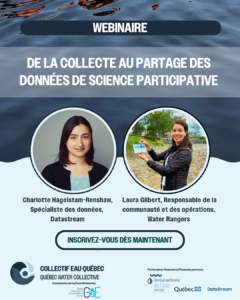
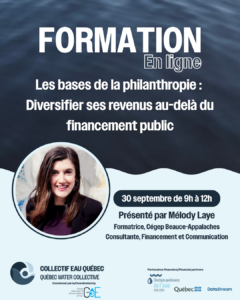
- Webinaire : Mobilisation citoyenne pour l’eau
- Webinaire : Valeur de la participation citoyenne pour l’eau
- Série de webinaires : La science participative en action – Découverte des principaux programmes de science participative au Québec
- Webinaire : Comment (ne pas) faire échouer son projet de science et recherche participative?
- Introduction aux données ouvertes : Le cas de la ville de Montréal
- Visionnez les webinaires passés
Questions or comments
Contact us at: collectif@g3e-ewag.ca
Financial partners